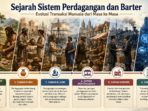

SILTV.COM – Before the invention of coins, banknotes, or digital transactions, how did early humans get the things they needed to survive? The answer lies in one of the oldest economic mechanisms in human history: the barter system.
Barter was the foundational form of trade that allowed individuals and communities to exchange goods and services directly without using money as an intermediary. When a person needed a resource they could not produce themselves such as salt, tools, or specific agricultural crops they had to find someone else who possessed that item and was willing to trade it for something they offered in return.
While this concept sounds simple, tracing its origins takes us thousands of years back into prehistory. So, when exactly did humanity start bartering?
The Genesis of Barter: The Agricultural Era
The origins of the barter system are closely tied to the transition into the Neolithic Period (also known as the New Stone Age), which began roughly 10,000 years ago. It is important to note that while 10,000 BP is a general global benchmark, the exact timeframe for entering this era varied across different regions of the world.
During this period, early human society underwent a monumental transformation known as the Neolithic Revolution (or agricultural revolution). Prior to this phase, humans lived as nomadic hunter-gatherers, moving constantly in search of wild food and natural shelter. However, the discovery of agriculture changed everything:
Permanent Settlements: Humans stopped roaming and began building small, organized villages.
Food Production: Instead of merely gathering wild plants and hunting animals, humans became food producers through farming and animal domestication.
Economic Surpluses: Agriculture allowed communities to produce more food than they needed for immediate survival, creating a surplus of goods.
This shift from a survival-based nomadic life to a settled, food-producing society laid the ground rules for trade. Having a surplus meant that a farmer might have extra grain but lack tools, while a craftsman had extra clay pots but needed food. The natural solution to this imbalance was barter.
What Was Traded During the Neolithic Era?
In prehistoric times, the items exchanged through barter reflected the immediate survival needs and technological capabilities of the society. Rather than luxury items, goods were primarily practical and daily necessities.
Commonly bartered goods included:
- Agricultural Produce: Surplus grains, vegetables, and cultivated crops.
- Handicrafts & Tools: Pottery, stone adzes (beliung), primitive jewelry, and woven textiles.
- Preserved Foods: Dried fish, which provided a durable source of protein for inland communities.
- Essential Minerals (Salt): Salt was a critical commodity, especially for inland populations who used it for food preservation and health. Coastal communities often produced salt and traded it with rural settlements in exchange for crops or crafted goods.
Early Transportation and the Expansion of Trade Routes
Barter was not confined strictly within a single village. As communities specialized in different resources, long-distance trade networks began to take shape. Goods were transported over considerable distances across land, rivers, and coastal waters.
To facilitate long-distance exchanges, prehistoric humans utilized:
Footpaths & Overland Trails: Walking long distances carrying heavy loads.
River Navigation: Using simple bamboo rafts (rakit) to move along inland waterways.
Maritime Routes: Employing canoes and dugout boats to travel along coasts and across small bodies of water.
This movement of goods had a far-reaching impact beyond economics. As people traveled to trade, they interacted with different cultures, shared ideas, spread technologies, and built social connections between previously isolated regions.
The Limitations of Barter and the Path to Currency
While the barter system was a major milestone in human civilization, it came with significant practical limitations:
The Double Coincidence of Wants: For a barter transaction to succeed, both parties had to want exactly what the other person was offering. If a farmer needed pottery, but the potter didn’t need grain, no trade could occur.
Lack of a Common Unit of Value: Determining how many clay pots were equal to a bag of grain or a piece of dried fish was subjective and difficult to standardize.
Perishability: Many bartered items, such as fresh agricultural goods, spoiled quickly if not traded immediately.
These challenges eventually led ancient civilizations to seek a more efficient medium of exchange, giving rise to commodity money (such as cowrie shells, salt, or livestock) and eventually minted metal coins.
Conclusion
The barter system represents one of humanity’s earliest steps toward organized society and global economics. Emerging around 10,000 years ago during the Neolithic period, it transformed early humans from isolated gatherers into interconnected communities. Through the exchange of crops, tools, and salt across rivers and lands, barter not only fulfilled basic human needs but also paved the way for cultural exchange and human connection.
Reference
Poesponegoro, Marwati Djoened & Nugroho Notosusanto (Eds). (2008). Sejarah Nasional Indonesia I: Zaman Prasejarah di Indonesia. Jakarta: Balai Pustaka.